


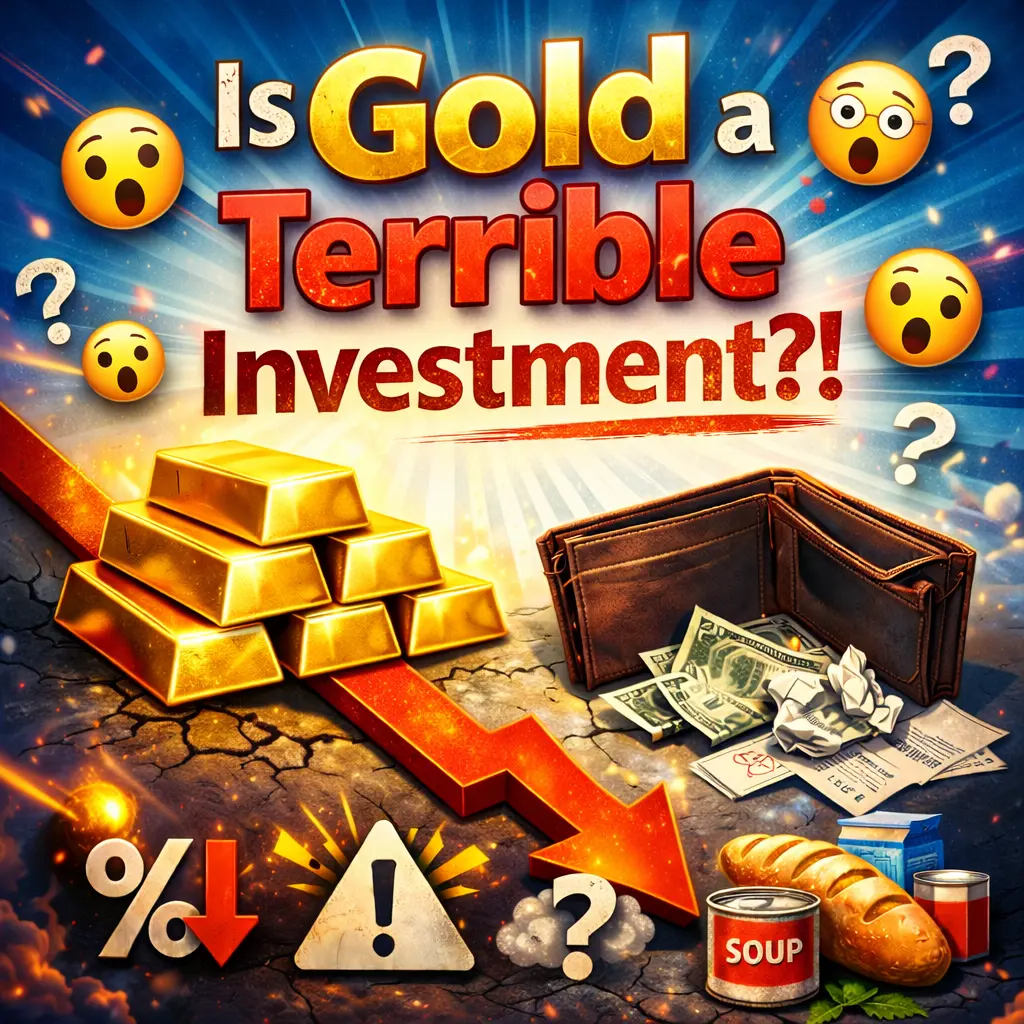
Gold has occupied a unique place in human history. It has served as money, ornamentation, and a symbol of status. But history alone does not make gold a good investment—or a reliable store of value for individuals today.
Over long periods, gold’s real return after inflation has been roughly 0–1%. Unlike productive assets, gold generates no income, does not compound, and relies entirely on price appreciation driven by demand. While gold has occasionally outperformed stocks and other asset classes, this has largely occurred during extreme economic environments, such as periods of high inflation or systemic fear. Outside of those scenarios, gold has often lagged behind productive investments.
THE PRACTICAL REALITY FOR INDIVIDUALS
Most individuals who invest in gold do so through physical bullion or coins. This comes with built-in friction: purchase premiums, sale discounts, and ongoing storage and insurance costs. These factors materially reduce returns and diminish gold’s effectiveness as an investment, making it a weak and unreliable store of value for most people.
Gold’s price is also heavily influenced by sentiment—fear, distrust of governments, and anxiety over currency stability. When fear rises, gold becomes more attractive. When confidence returns, gold often loses momentum. In this sense, gold is inherently speculative—not because it is volatile, but because its value depends more on collective emotion than on cash flow or productivity. Its price often functions more like a fear indicator than the result of fundamental investment drivers.
Gold can play a role during hyperinflation, currency transitions, or periods of severe loss of confidence in fiat money. Even then, however, it is rarely the most practical asset. In the absence of a functioning monetary system, utility outweighs scarcity. History shows that food, clothing, fuel, and shelter often command more immediate value than precious metals. Gold may preserve relative value over time, but its usefulness to individuals declines sharply when survival and practicality take precedence.
Gold is best understood as a psychological hedge—a way to feel protected against uncertainty rather than a comprehensive financial solution. That doesn’t make gold evil or useless. But it does make it easy to oversell.
CONCLUSION
For most investors, gold is not a foundation. It is a niche asset suited to specific beliefs and extreme scenarios—not a substitute for productive, compounding investments.
This is not investment advice. If you are considering an investment in gold, speak with a fiduciary financial advisor about your specific needs. If you think I’m missing something, let’s talk about it in the comments.